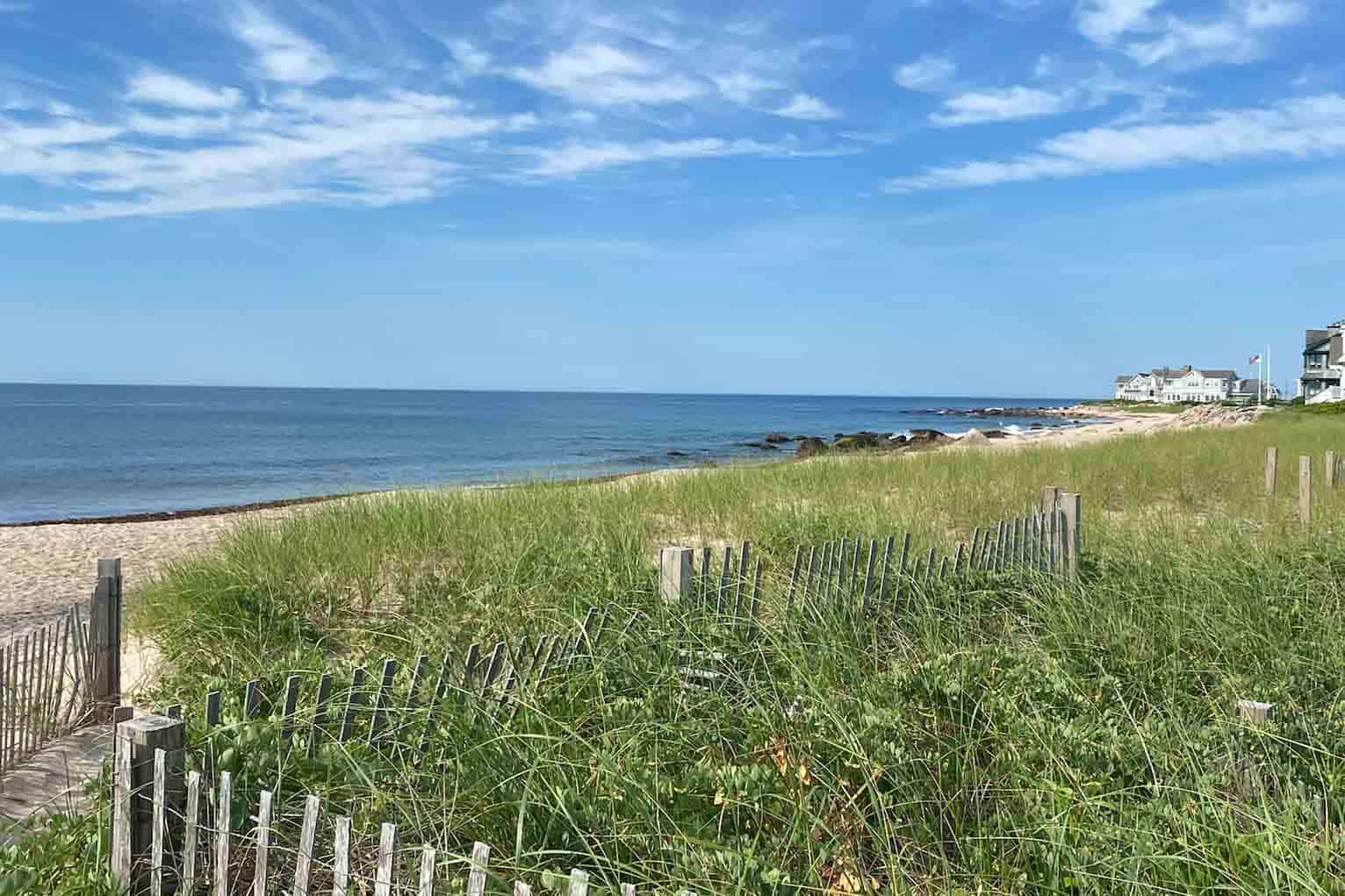

Billions of birds migrate south each fall and north every spring, with seventy-to-eighty percent traveling at night to avoid predators. They use the light from the moon and stars, as well as the earth’s magnetic field, to navigate. However, most migrating birds need to stop and refuel, and rest along the way, with some taking weeks to reach their destination.
Birds Are Attracted to Light
We’ve learned that migrating at night has its challenges – one of the biggest being artificial lights on buildings in cities and surrounding suburbs. The light can be very disorienting for birds, causing confusion and hampering their natural navigation skills. The net result is that hundreds of millions of birds die each year in the US as a result of window strikes, while other birds fly around in circles, become exhausted and just drop to the ground.
Atlantic Flyway and Coastal Rhode Island
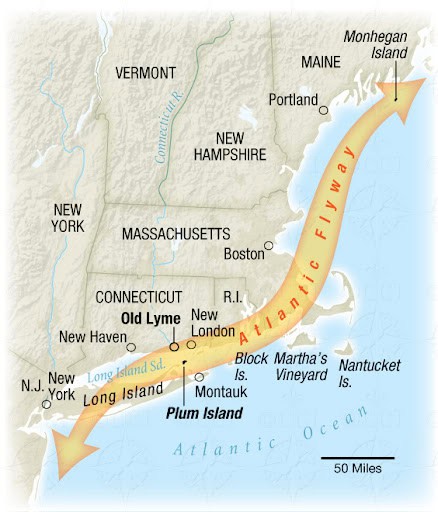
Coastal Rhode Island provides an important migratory path for birds. In fact, our area is fortunate enough to be directly along the Atlantic Coast Flyway where migratory birds pass through each year. Reducing or cutting out lights during migration can truly make a difference.
Lights and Windows in the “Vegetative Zone”
Interestingly, Audubon estimates that less than one percent of bird mortality due to window strikes occur on high-rise buildings. Instead, fifty-six percent occur on low-rise buildings (with glass installed up to 100 feet in height) with the remaining forty-four percent occurring around homes.
In either scenario, know that most collisions happen in the “vegetative zone” (from the grass to the height of the trees), where birds actively forage for food and seek shelter in the AM after a long-night’s journey. It is during this time, that the birds – especially songbirds such as warblers, sparrows and thrushes – are vulnerable, as they frantically refuel and rest-up for the next leg of their trek.
Take Action
Given this, we encourage everyone to turn artificial lights down or off between 11pm-to-6am during Spring Migration (which occurs between mid-March through mid-June, with “peak” migration in Rhode Island late April through the end of May) – and again during Fall Migration (mid-September through mid-November). The 4-5-week peak migration periods are especially important, as this is when the bulk of the passage takes place.
Further, do what you can to make your windows “bird-friendly” so that birds can more easily see them and take corrective action to avoid collisions. Here are some tips from the American Bird Conservancy with links to products that you can purchase online. And here is a link to an Amazon webpage where that has various tapes and decals that do a great job, and inexpensively.
How Can You Help?
- Turn off lights (or draw blinds) from 11pm until 6am during migration
- Direct outdoor lights to point downward, instead of upward into the sky
- Switch outdoor floodlights to timed lights or motion sensor lights
- Encourage the businesses you frequent to turn off their lights or reduce the amount of time their lights are on at night
- Install decals / reflective tape, hang ribbons, or install window screens / netting to make your windows look like a barrier
Primary Sources: The Audubon Society and American Bird Conservancy, as well as QCC’s Wildlife and Habitat and Dark Skies committees.